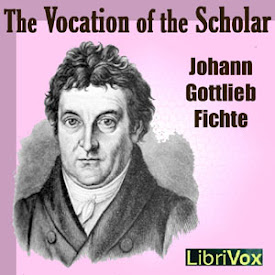
The Vocation of the Scholar
Leído por LibriVox Volunteers
The Vocation of the Scholar presents a series of profound lectures by Johann Gottlieb Fichte, a pivotal figure in German idealism. Delivered at Jena University in 1794, these lectures explore the role and responsibilities of scholars in society, emphasizing the importance of self-consciousness and the pursuit of knowledge.
Fichte's work serves as a bridge between the philosophical ideas of Immanuel Kant and Georg Wilhelm Friedrich Hegel, offering original insights into the nature of consciousness and subjectivity. Through his eloquent discourse, he challenges scholars to engage deeply with their intellectual vocation and to consider the ethical implications of their work.
This collection not only reflects Fichte's philosophical depth but also his vision of education as a transformative force in society. As one of the early proponents of German nationalism, his thoughts resonate with themes of identity and purpose, making this work relevant for those interested in philosophy, education, and cultural heritage.
Capítulos
Select a chapter to play
| Introduction, by William Smith | 12:39 | Leído por Craig Campbell | |
| Preface | 5:26 | Leído por Craig Campbell | |
| Lecture I. The Absolute Vocation of Man | 18:41 | Leído por John Van Stan | |
| Lecture II. The Vocation of Man in Society | 28:46 | Leído por Craig Campbell | |
| Lecture III. The Distinction of Classes in Society | 34:49 | Leído por Lucretia B. | |
| Lecture IV. The Vocation of the Scholar | 31:03 | Leído por Craig Campbell | |
| Lecture V. Examination of Rousseau's Doctrine Concerning the Influence of Art and Science on the Well-Being of Man | 28:58 | Leído por Craig Campbell |
Reseñas
powerful and enlightened message!

adam
A powerful and clear message from a widely acknowledged great and influential thinker. This goes directly to how to live a good, noble, and honorable life, addressing the moral questions that arise for all men. The title of addressing the scholar could be seen as addressing those that would read and think about such questions. Well read and very accessible once one gets used to his way of writing.